Cloud Computing as the Backbone of the Digital Economy
The global cloud computing industry has firmly established itself as the foundational infrastructure of the digital economy in 2026. What began as a cost-saving alternative to on-premise IT systems has now evolved into a critical enabler of innovation, scalability, and business transformation across industries.
Organizations are increasingly relying on cloud platforms to support data-intensive applications, artificial intelligence workloads, and real-time analytics. As digital transformation accelerates, cloud adoption is no longer optional - it is a strategic necessity for businesses seeking agility and competitive advantage.
The rapid expansion of remote work, digital services, and connected ecosystems has further reinforced the importance of cloud infrastructure. Enterprises, startups, and governments alike are leveraging cloud technologies to improve operational efficiency, enhance customer experiences, and drive innovation.
For IT decision-makers, CFOs, and cloud architects, understanding cloud computing market share**, **evolving cloud spending, and trends in hybrid cloud adoption is essential for making informed investment and architecture decisions. The competitive dynamics among major providers and shifting enterprise requirements are reshaping the cloud landscape in real time.
In addition, several structural and technological trends are accelerating the role of cloud computing in the global economy:
• Increasing adoption of cloud-native architectures, including microservices and containerization, enabling faster application development and deployment
• Rising demand for real-time data processing driven by applications such as financial trading, IoT analytics, and digital customer experiences
• Integration of advanced technologies like Artificial Intelligence and machine learning directly into cloud platforms, making them more accessible to businesses of all sizes
• Expansion of edge computing capabilities, allowing data processing closer to the source and reducing latency for critical applications
• Growth of platform ecosystems where cloud providers offer integrated services spanning infrastructure, analytics, security, and application development
• Increasing reliance on cloud infrastructure to support emerging technologies such as autonomous systems, smart cities, and digital twins
• Rapid scaling capabilities that allow organizations to respond quickly to market changes, seasonal demand, and unexpected disruptions
• Enhanced collaboration tools and cloud-based productivity platforms supporting distributed and global workforces
• Growing importance of APIs and interoperability, enabling seamless integration between different cloud services and enterprise systems
• Continuous innovation in cloud security frameworks, ensuring protection against evolving cyber threats while maintaining compliance with global regulations
These developments highlight how cloud computing is no longer just an IT solution but a strategic foundation for digital transformation, innovation, and long-term business resilience.
Additional macro trends reinforcing cloud dominance include:
-
Rise of digital-first business models across industries
-
Increasing reliance on real-time data processing and analytics
-
Expansion of 5G networks enabling edge-cloud integration
-
Growing importance of cloud in supporting AI and automation at scale
-
Acceleration of platform-based ecosystems and digital services
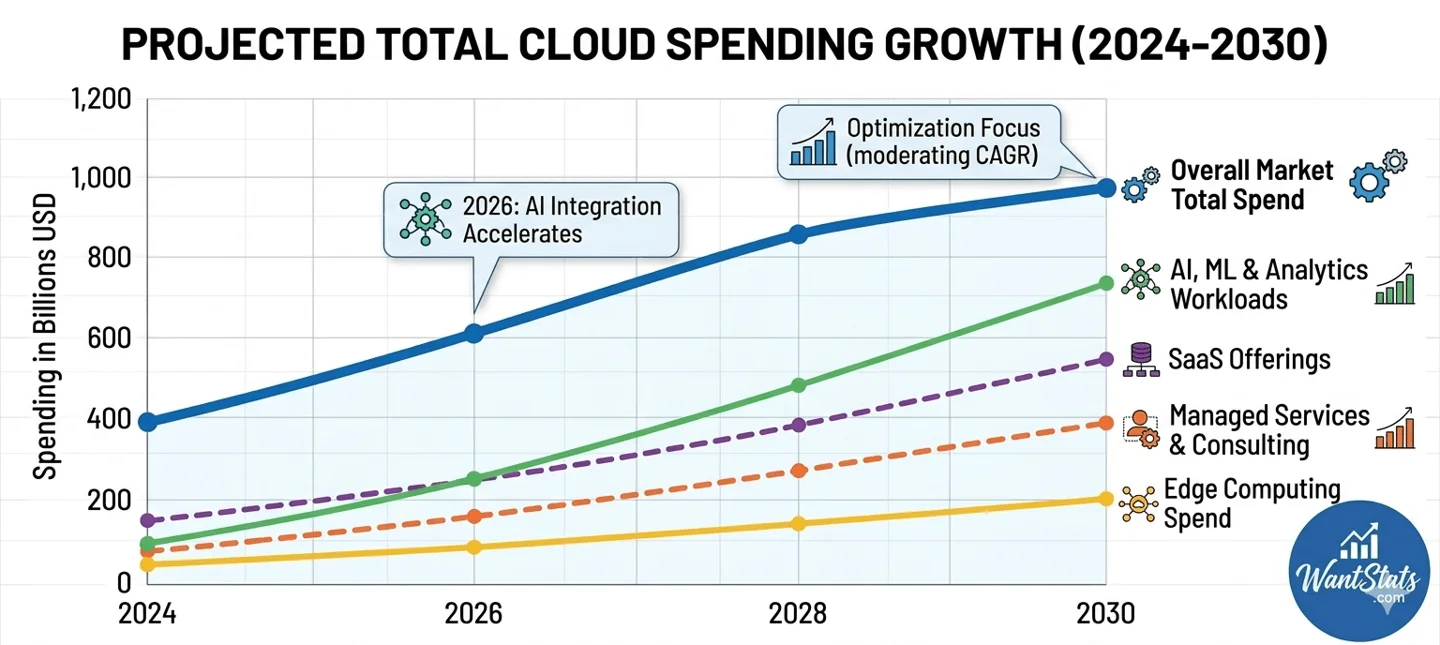
Total Cloud Spending & Year-on-Year Growth Trends
Global cloud spending continues to rise at a significant pace, reflecting the increasing reliance on cloud-based services across sectors. In 2026, total cloud expenditure is projected to surpass previous records, driven by enterprise migration, AI adoption, and the growing demand for scalable infrastructure.
Several key factors are driving this growth:
-
Expansion of data-driven business models requiring scalable storage and compute power
-
Increasing adoption of AI, machine learning, and big data analytics workloads
-
Growth in Software-as-a-Service (SaaS), Platform-as-a-Service (PaaS), and Infrastructure-as-a-Service (IaaS) offerings
-
Rising demand for digital services across e-commerce, healthcare, finance, and manufacturing
-
Acceleration of cloud-native application development
Year-on-year growth rates remain strong, although slightly moderating compared to the hyper-growth phase of the early 2020s. Enterprises are now shifting from rapid adoption to optimization, focusing on maximizing return on investment from cloud deployments.
Spending patterns are also evolving. Organizations are allocating budgets not only for infrastructure but also for advanced services such as AI platforms, data analytics, cybersecurity, and edge computing. This shift reflects the maturation of the cloud market from basic infrastructure provisioning to high-value digital services.
Additional spending insights include:
-
Increased allocation toward managed services and cloud consulting
-
Rising investments in industry-specific cloud solutions (finance, healthcare, retail)
-
Growth in edge computing spend to support low-latency applications
-
Higher demand for data storage due to exponential data generation
-
Expansion of cloud budgets within overall IT spending portfolios
From a regional perspective, North America continues to lead in cloud spending, followed by Europe and Asia-Pacific. Emerging markets are also witnessing rapid growth as digital infrastructure investments increase.
AWS vs Azure vs Google Cloud - Market Share Breakdown
The global cloud market is dominated by three major players: Amazon Web Services, Microsoft Azure, and Google Cloud. Together, these providers account for a significant share of the global cloud computing market.
Amazon Web Services (AWS) remains the market leader, benefiting from its early-mover advantage and extensive portfolio of cloud services. AWS offers a comprehensive range of solutions, including compute, storage, databases, machine learning, and enterprise applications.
Microsoft Azure has emerged as a strong competitor, leveraging its enterprise relationships and integration with existing Microsoft products. Azure's hybrid cloud capabilities and enterprise-focused solutions have contributed to its rapid growth.
Google Cloud continues to gain market share, particularly in data analytics, AI, and machine learning. Its strengths in big data processing and open-source technologies make it a preferred choice for data-driven organizations.
Additional insights into the competitive landscape include:
• Amazon Web Services continues to lead in overall cloud computing market share**,** driven by its global infrastructure footprint and continuous expansion of services
• Microsoft Azure is experiencing strong enterprise adoption due to seamless integration with enterprise software ecosystems like Windows Server, Microsoft 365, and enterprise security tools
• Google Cloud is differentiating through advanced AI/ML capabilities, data analytics platforms, and leadership in open-source technologies such as Kubernetes
• Pricing competition among the Big Three is intensifying, with flexible pricing models, discounts, and bundled services becoming key differentiators
• Expansion of global data centers and availability zones is improving latency, compliance, and service reliability across regions
• All three providers are heavily investing in industry-specific cloud solutions tailored for sectors such as healthcare, finance, retail, and manufacturing
• Increasing focus on developer ecosystems, APIs, and platform services to attract startups and enterprise developers
• Growth in managed services and consulting offerings to support complex cloud migrations and multi-cloud strategies
• Rising importance of partner ecosystems, including system integrators and independent software vendors (ISVs), in driving adoption
• Strategic investments in edge computing and distributed cloud infrastructure to support real-time and low-latency applications
• Strong emphasis on security, compliance certifications, and data governance capabilities to meet global regulatory requirements
These factors highlight how competition among AWS vs Azure vs Google Cloud is evolving beyond basic infrastructure services toward integrated platforms that combine compute, data, AI, and industry-specific solutions.
Hybrid & Multi-Cloud Adoption across Industries
One of the most significant trends in 2026 is the widespread adoption of hybrid cloud adoption and multi-cloud strategies. Organizations are increasingly combining public cloud, private cloud, and on-premise infrastructure to meet diverse operational requirements.
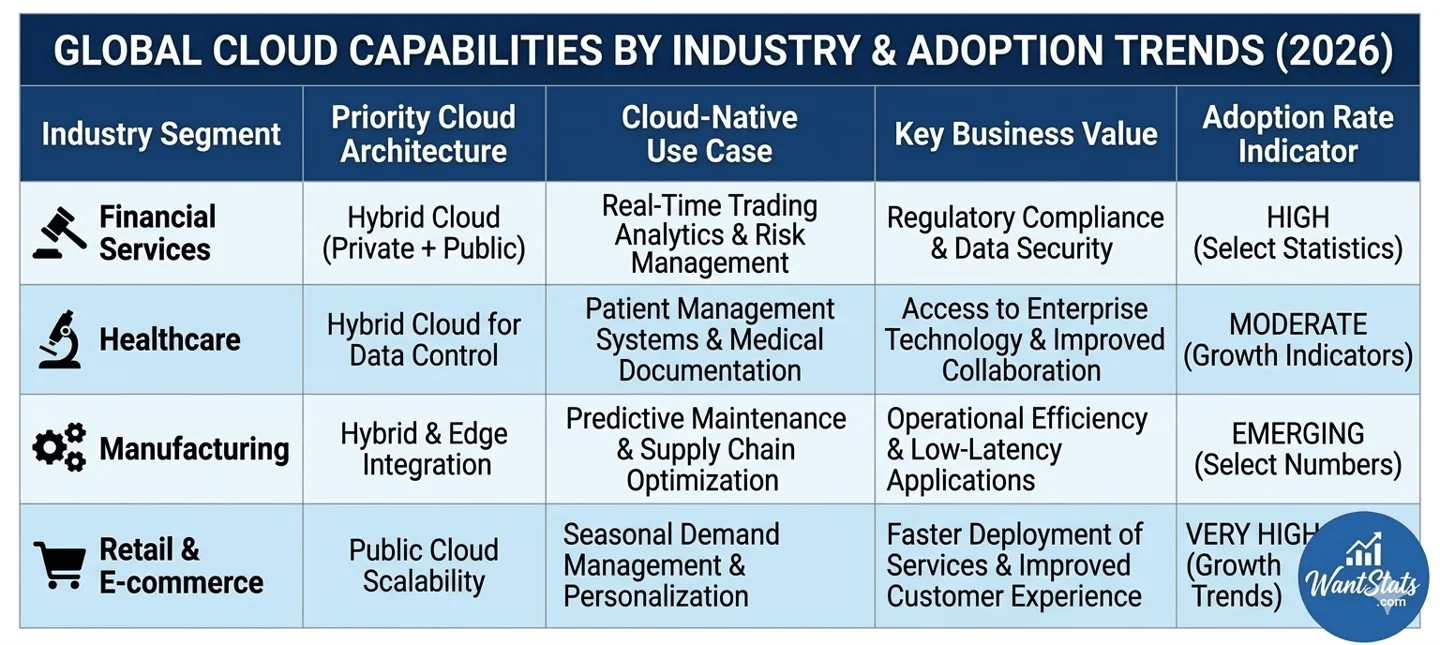
Hybrid cloud models allow businesses to maintain control over sensitive data while leveraging the scalability of public cloud platforms. This approach is particularly valuable for industries with strict regulatory requirements, such as healthcare, finance, and government.
Multi-cloud strategies, on the other hand, involve using multiple cloud providers to avoid vendor lock-in, improve resilience, and optimize performance. Many enterprises are distributing workloads across AWS, Azure, and Google Cloud to achieve greater flexibility.
Industry-specific adoption trends include:
-
Financial services prioritizing hybrid cloud for regulatory compliance and data security
-
Healthcare organizations leveraging cloud for data analytics and patient management systems
-
Manufacturing companies adopting cloud for IoT and supply chain optimization
-
Retail and e-commerce businesses using cloud for scalability during peak demand periods
The rise of containerization and orchestration technologies, such as Kubernetes, is further enabling seamless workload portability across cloud environments.
Additional trends driving hybrid and multi-cloud adoption:
-
Increased demand for workload portability and interoperability
-
Adoption of cloud management platforms for centralized control
-
Growth of edge computing integrated with hybrid architectures
-
Rising use of APIs and microservices for flexible application deployment
-
Enhanced disaster recovery and business continuity capabilities
As hybrid and multi-cloud adoption increases, organizations are investing in cloud management platforms and integration tools to ensure smooth operations across diverse environments.
Cloud Migration Trends: SMEs vs Enterprises
Cloud migration patterns vary significantly between small and medium-sized enterprises (SMEs) and large enterprises.
SMEs are adopting cloud solutions rapidly due to their cost-effectiveness, scalability, and ease of deployment. For smaller businesses, cloud platforms eliminate the need for significant upfront investment in IT infrastructure, enabling faster digital transformation.
Key drivers for SME cloud adoption include:
-
Lower capital expenditure and pay-as-you-go pricing models
-
Access to enterprise-grade technology without large investments
-
Improved collaboration and remote work capabilities
-
Faster deployment of applications and services
In contrast, large enterprises are taking a more strategic and phased approach to cloud migration. Many organizations are modernizing legacy systems, migrating critical workloads, and adopting hybrid architectures to balance performance, cost, and security.
Enterprise migration strategies often involve:
-
Rehosting (lift-and-shift) of existing applications
-
Refactoring applications for cloud-native environments
-
Implementing DevOps and continuous integration/continuous deployment (CI/CD) pipelines
-
Integrating cloud with existing on-premise systems
Despite the benefits, cloud migration also presents challenges, including data migration complexity, application compatibility, and cost management.
Security, Cost & Sustainability in Cloud Spending
As cloud spending continues to grow, organizations are placing greater emphasis on security, cost optimization, and sustainability.
Security remains a top priority, as cloud environments handle vast amounts of sensitive data. Cloud providers are investing heavily in advanced security measures, including encryption, identity and access management, and threat detection systems. However, organizations must also implement robust security practices to protect their data and applications.
Cost management is becoming increasingly important as cloud usage expands. Many organizations are adopting FinOps practices to monitor and optimize cloud expenses. This includes rightsizing resources, eliminating unused services, and leveraging cost management tools.
Sustainability is emerging as a key consideration in cloud strategies. Data centers consume significant amounts of energy, prompting cloud providers to invest in renewable energy and energy-efficient infrastructure.
Key trends in this area include:
-
Adoption of green cloud initiatives and carbon-neutral data centers
-
Increased transparency in energy consumption and emissions reporting
-
Optimization of workloads to reduce energy usage and costs
-
Integration of sustainability metrics into cloud decision-making processes
Additional considerations shaping cloud strategies:
-
Implementation of zero-trust security models across cloud environments
-
Rising importance of compliance with global data protection regulations
-
Use of AI-driven tools for threat detection and anomaly monitoring
-
Increased focus on cost predictability and budgeting accuracy
-
Integration of sustainability goals into enterprise IT strategies
Balancing security, cost, and sustainability is essential for maximizing the value of cloud investments.
Conclusion: The Next Cloud Battleground
The cloud computing market in 2026 is characterized by rapid growth, intense competition, and continuous innovation. Analysis of cloud computing market share, cloud spending, and hybrid cloud adoption trends reveals a dynamic and evolving landscape.
While Amazon Web Services, Microsoft Azure, and Google Cloud continue to dominate the market, the next phase of competition is shifting toward higher-value services such as AI, data analytics, and industry-specific solutions.
The future of cloud computing will be shaped by:
-
Increasing demand for AI-driven and data-centric services
-
Expansion of edge computing and distributed cloud models
-
Growing importance of hybrid and multi-cloud architectures
-
Continued focus on security, cost optimization, and sustainability
Additional forward-looking trends include:
-
Emergence of industry-specific cloud platforms tailored to vertical needs
-
Growth of sovereign cloud initiatives driven by data localization requirements
-
Expansion of AI-as-a-Service offerings across cloud ecosystems
-
Increased competition in developer tools and platform ecosystems
-
Convergence of cloud, edge, and IoT technologies
For IT decision-makers, CFOs, and cloud architects, the key challenge will be navigating this complex landscape while maximizing the return on cloud investments.
As cloud computing continues to evolve, it will remain a central pillar of the digital economy, enabling innovation and driving business growth across industries. The next cloud battleground will not just be about infrastructure dominance - but about delivering integrated, intelligent, and sustainable digital solutions.