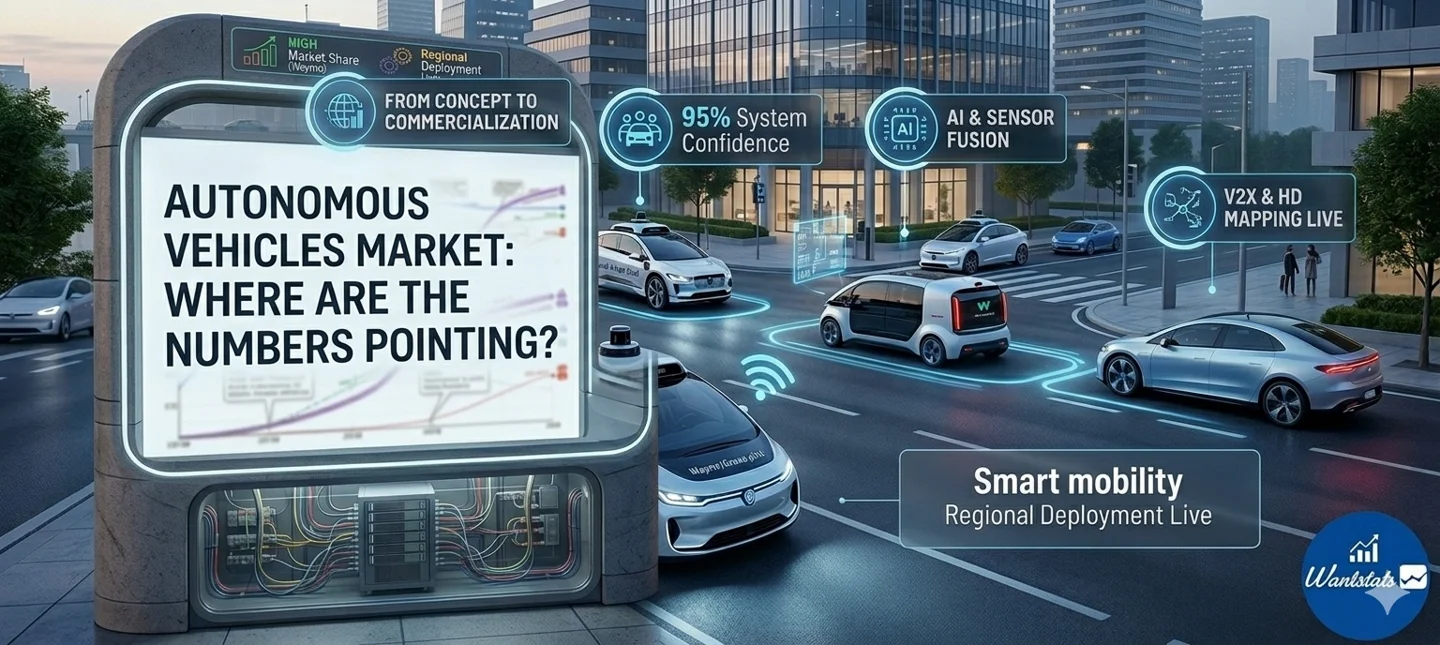
Autonomous Vehicles Navigating the Shift from Concept to Commercialization
The global autonomous vehicles (AV) industry is entering a transformative phase in 2026 as technological advancements, regulatory developments, and growing investments accelerate the transition from concept to commercialization. What was once a futuristic vision is now steadily becoming a reality, with self-driving technologies being integrated into real-world mobility systems.
Autonomous vehicles rely on a combination of advanced technologies, including Artificial Intelligence, machine learning, sensor fusion, and real-time data processing, to navigate roads with minimal or no human intervention. These systems are designed to improve safety, enhance efficiency, and reduce human error - the leading cause of road accidents globally.
For auto industry stakeholders and mobility investors, understanding self-driving car statistics and evolving EV and AV trends is critical to identifying long-term opportunities. The increasing AV adoption rate across pilot programs, ride-hailing services, and logistics applications highlights the growing commercial viability of this technology.
In 2026, autonomous mobility is no longer limited to experimental testing. Several companies are deploying AV fleets in controlled environments, while advanced driver-assistance systems (ADAS) are becoming standard features in modern vehicles. This gradual integration is bridging the gap between traditional vehicles and fully autonomous systems.
Global Autonomous Vehicle Market Size & Growth Projections
The autonomous vehicle market size is expanding rapidly, driven by technological innovation, rising demand for smart mobility solutions, and increasing investments from both public and private sectors. Industry projections indicate strong growth through 2035, with the market expected to reach hundreds of billions of dollars in value.
Several factors are contributing to this growth trajectory:
-
Continuous advancements in AI-driven perception and decision-making systems
-
Integration of autonomous capabilities with electric vehicles
-
Expansion of mobility-as-a-service (MaaS) platforms
-
Increasing focus on road safety and traffic efficiency
-
Growing investments in smart city infrastructure
Major automotive and technology companies such as Tesla, Waymo, and General Motors are investing heavily in autonomous technologies, driving innovation and competition within the industry.
The emergence of robotaxi services and autonomous delivery solutions is also expanding the addressable market. These applications are expected to play a significant role in early revenue generation, particularly in urban environments.
From a regional perspective, North America and the Asia-Pacific are leading in terms of development and deployment, while Europe is focusing on regulatory frameworks and safety standards. This global competition is accelerating technological progress and shaping the future of mobility.
As the ecosystem matures, the market is diversifying across hardware (sensors, chips), software (AI algorithms), and services (fleet management, mobility platforms), creating multiple investment opportunities.
Levels of Autonomy on the Road Today
Understanding the levels of autonomy is essential to evaluating current market progress and future potential. The industry follows a classification system defined by the SAE International, which outlines six levels of vehicle autonomy:
-
Level 0 (No Automation): Fully human-controlled driving
-
Level 1 (Driver Assistance): Basic features such as cruise control
-
Level 2 (Partial Automation): Combined functions like steering and acceleration support
-
Level 3 (Conditional Automation): Vehicles can handle certain driving tasks with human oversight
-
Level 4 (High Automation): Vehicles operate autonomously in specific conditions or environments
-
Level 5 (Full Automation): Complete autonomy without human intervention
As of 2026, most commercially available vehicles operate at Level 2, with some Level 3 capabilities emerging in select markets. Companies are actively testing Level 4 systems in controlled environments such as urban centers and dedicated routes.
The gap between Level 2 and Level 5 remains significant due to technical challenges related to perception, decision-making, and safety validation. However, steady progress in sensor technologies and AI is gradually bridging this gap.
These advancements are reflected in improving the AV adoption rate**,** particularly in fleet-based applications such as ride-hailing and logistics.
Several additional factors are shaping the progression of autonomy levels across the industry:
• Increasing deployment of advanced sensor suites, including LiDAR, radar, and high-resolution cameras, to enhance environmental perception and object detection accuracy
• Continuous improvements in AI-driven decision-making systems, enabling vehicles to better handle complex and unpredictable driving scenarios
• Expansion of real-world pilot programs in smart cities, allowing companies to gather large-scale operational data for system refinement
• Integration of high-definition (HD) mapping and real-time data updates to improve navigation precision and route optimization
• Growing role of vehicle-to-everything (V2X) communication, enabling vehicles to interact with infrastructure, traffic systems, and other connected devices
• Gradual rollout of Level 3 autonomy in premium vehicles, particularly in highway driving scenarios where conditions are more predictable
• Increased focus on redundancy systems (backup controls and fail-safe mechanisms) to ensure safety in case of system failures
• Rising adoption of autonomous technologies in commercial fleets, including trucking, delivery vehicles, and public transportation systems
• Ongoing advancements in simulation and virtual testing environments, allowing companies to validate autonomous systems more efficiently and at scale
• Strong alignment between autonomous driving and electric vehicle platforms, reinforcing broader EV and AV trends across the mobility ecosystem
As these technological and operational improvements continue, the industry is expected to move steadily toward higher levels of autonomy, with Level 4 deployments expanding into more real-world environments over the coming years.
Key Players Driving Innovation & Market Share
The autonomous vehicle market is highly competitive, with both automotive manufacturers and technology companies vying for leadership positions. Among the key players are Tesla, Waymo, and General Motors through its Cruise division.
Tesla is leveraging its large fleet of connected vehicles to collect real-world driving data, enabling continuous improvement of its Full Self-Driving (FSD) system. Its approach focuses on scaling autonomy through software updates and AI training.
Waymo, a subsidiary of Alphabet Inc., is widely recognized for its leadership in robotaxi services. The company has deployed autonomous ride-hailing services in select U.S. cities, demonstrating the commercial viability of Level 4 autonomy.
General Motors Cruise is focusing on urban autonomous mobility, with plans to expand robotaxi operations across multiple cities. The company is investing heavily in both vehicle development and software capabilities.
Other notable players include NVIDIA, which provides AI computing platforms for autonomous systems, and Baidu, which is advancing autonomous driving in China.
The competitive landscape is also shaped by partnerships between automakers, technology firms, and mobility service providers, accelerating innovation and reducing time to market.
Regulatory Landscape: Country-by-Country Developments
Regulation plays a critical role in shaping the adoption and deployment of autonomous vehicles. Governments worldwide are developing policies to ensure safety while enabling innovation.
In the United States, federal and state authorities are allowing controlled testing and limited commercial deployment of autonomous vehicles. Regulatory frameworks are evolving to address safety standards, liability issues, and data privacy concerns.
In Europe, countries are adopting a more cautious approach, emphasizing strict safety regulations and certification processes. The region is focusing on harmonizing standards across member states to facilitate cross-border mobility.
Asia-Pacific is emerging as a major hub for AV development, with countries like China and Japan actively supporting autonomous vehicle testing and deployment through government-backed initiatives.
Regulatory uncertainty remains a key challenge, as inconsistent policies across regions can slow down global deployment. However, ongoing collaboration between governments and industry stakeholders is helping to create more standardized frameworks.
Additional regulatory trends shaping the autonomous vehicle market include:
• Introduction of pilot zones and smart mobility corridors in major cities to safely test and scale autonomous driving technologies
• Development of unified safety assessment frameworks, including simulation-based validation and real-world performance benchmarks
• Increasing emphasis on cybersecurity regulations to protect connected vehicle systems from potential cyber threats
• Growing focus on data governance policies, ensuring secure collection, storage, and usage of vehicle-generated data
• Establishment of liability frameworks to determine responsibility in case of accidents involving autonomous vehicles
• Expansion of public-private partnerships to accelerate infrastructure readiness and regulatory innovation
• Integration of autonomous vehicles into broader smart city initiatives, aligning with urban mobility and sustainability goals
• Regulatory sandboxes allowing companies to experiment with new technologies under controlled conditions
• Gradual standardization of vehicle-to-everything (V2X) communication protocols to improve interoperability across regions
• Increased attention to ethical guidelines governing AI-based decision-making in autonomous systems
• Supportive policies for electric and autonomous vehicle convergence, reinforcing long-term EV and AV trends
As regulatory frameworks continue to evolve, they will play a decisive role in determining the pace of commercialization and the global AV adoption rate, balancing innovation with public safety and trust.
Consumer Trust & Safety Barriers
Despite technological progress, consumer trust remains one of the biggest barriers to widespread adoption of autonomous vehicles. Safety concerns, lack of awareness, and limited real-world exposure are influencing public perception.
Many consumers are hesitant to fully trust self-driving systems, particularly in complex driving scenarios. High-profile accidents involving autonomous vehicles have also contributed to skepticism.
Building trust requires consistent performance, transparent communication, and robust safety validation. Companies are investing heavily in testing and simulation to demonstrate reliability and reduce risk.
Another challenge is the ethical dimension of autonomous decision-making. Questions around how vehicles should respond in critical situations continue to be debated, influencing regulatory and public acceptance.
Infrastructure readiness is also a factor. Autonomous vehicles require well-maintained roads, clear signage, and advanced communication systems to operate effectively. Variability in infrastructure quality across regions can impact deployment timelines.
Improving consumer confidence will be critical to increasing the AV adoption rate and unlocking the full potential of the autonomous vehicle market.
Conclusion: Will Autonomous Vehicles Reach Mass Adoption by 2030?
The autonomous vehicle market in 2026 is at a critical inflection point, characterized by rapid technological advancements, increasing investments, and evolving regulatory frameworks. Analysis of self-driving car statistics and EV and AV trends suggests that the industry is making steady progress toward commercialization.
While fully autonomous vehicles (Level 5) may still be several years away, significant advancements in Level 3 and Level 4 systems are bringing practical applications closer to reality. The growth of robotaxi services, autonomous delivery solutions, and smart mobility platforms is expected to drive early adoption.
The future of the autonomous vehicle market size will depend on continued innovation, regulatory alignment, and improvements in consumer trust. Collaboration between technology companies, automakers, and governments will be essential to overcoming existing challenges.
For mobility investors and industry stakeholders, the key takeaway is that autonomous vehicles represent a long-term, high-impact opportunity. The transition to autonomous mobility will likely occur gradually, with incremental advancements shaping the path toward full autonomy.
By 2030, it is expected that autonomous vehicles will play a significant role in specific use cases and geographies, even if mass adoption is not yet fully realized. As the industry continues to evolve, the question is not whether autonomous vehicles will transform mobility - but how quickly they will redefine the future of transportation.